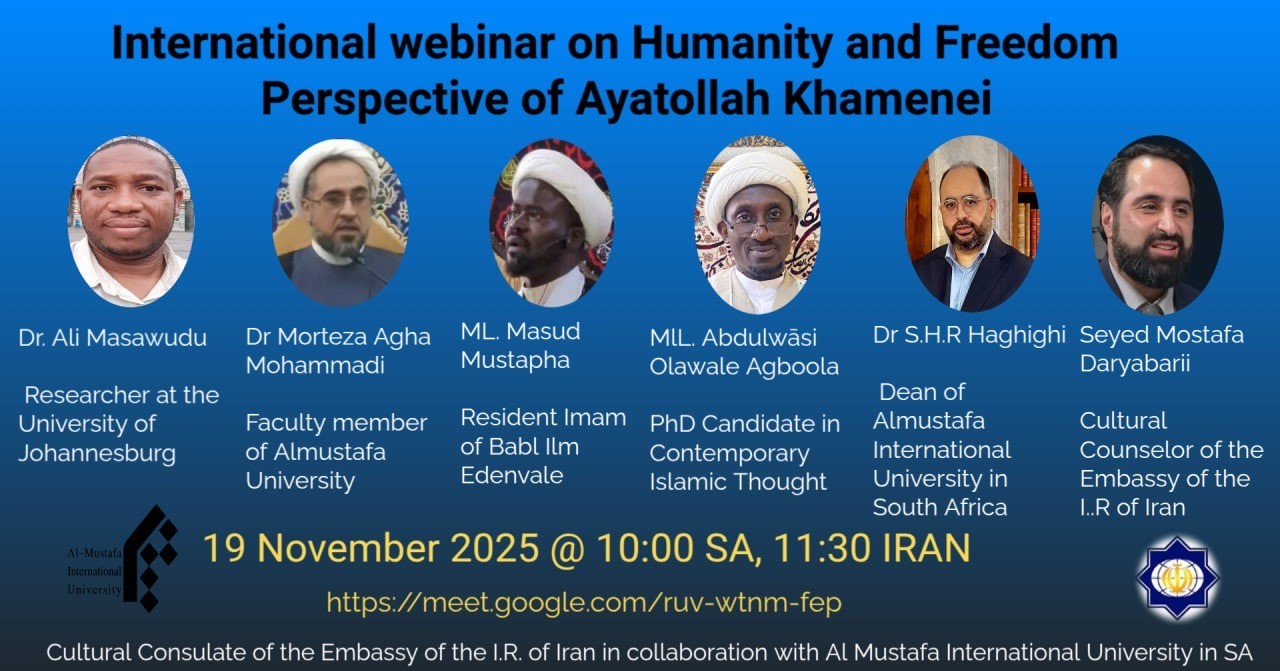
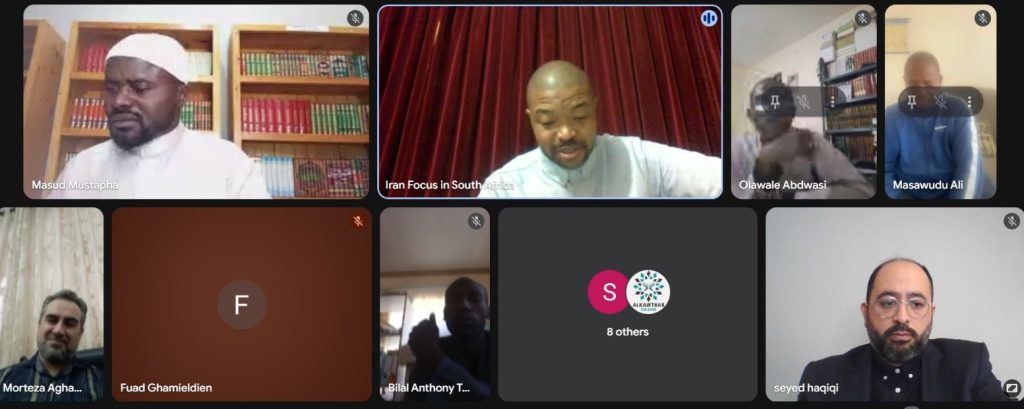
International webinar on Humanity and Freedom
Legitimate Freedom in the Islamic Paradigm: Foundations, Domains, and Limitations
Dr. Seyyed Hamid Reza Haqiqi
Dean of Al Mustafa International University in South Africa
Abstract
The concept of freedom is one of the most pivotal and challenging topics in
contemporary political and social thought. This research
examines the concept of “legitimate freedom” from an Islamic perspective. Its central
thesis is that freedom in Islam is not an absolute and unlimited value, but rather a divine
right imbued with responsibility, defined and delineated within the framework of
“legitimacy” (Mashru’iyyah).
Here, legitimacy is not based on the will of the majority, but on the immutable principles
of the Shari’ah (the Qur’an and Sunnah), with the aim of elevating the individual and
society. Using an analytical-descriptive method, this paper first explores the theological
and anthropological foundations of freedom (including the concepts of monotheism
(Tawhid), the human role as God’s vicegerent (Khilafah), and free will).
Subsequently, it analyzes various domains of legitimate freedom, including freedom of
belief and expression, political freedom and social participation (based on the principles
of consultation (Shura) and enjoining good and forbidding evil), and individual and
economic freedoms (within the framework of justice and ethics). Finally, the most
significant limitations on freedom, such as the preservation of public interest (Maslaha),
morality, the intellectual health of society, and the rights of others, are elucidated. The
conclusion is that the Islamic system, by providing a comprehensive value-based
framework, views freedom as a platform for human evolutionary progress, not as a tool
for libertinism.
Keywords: Legitimate Freedom, Islam and Freedom, Shari’ah, Public Interest, Individual
and Social Rights.
Introduction
In the modern era, the discourse on freedom is predominantly influenced by liberal
secular schools of thought, where individual liberty is often defined as an inviolable
principle supreme over other values. This perspective has sometimes led to a perceived
dichotomy between religion and freedom. The central question, therefore, is: Does Islam, as a comprehensive worldview, offer a concept of freedom? If so, what are its
characteristics and boundaries?
Rejecting this dichotomous view of religion and freedom, this paper argues that
Islam not only affirms freedom but also elevates it from a negative state (“freedom from”
constraint) to a positive one (“freedom for” transcendence) by providing a “legitimate”
framework. The objective of this study is to systematically articulate this framework and
answer the question: “What are the foundations, manifestations, and limits of legitimate
freedom from an Islamic perspective?”
1. Theoretical Foundations of Legitimate Freedom in Islam
Freedom in Islam is established upon several foundational pillars, without which its
concept remains incomplete:
* Monotheism (Tawhid) and Servitude (Ubudiyyah): Essentially, true freedom in
Islam is liberation from servitude to anything other than God. The Qur’anic verse “There
shall be no compulsion in [acceptance of] the religion” (Al-Baqarah 2:256) finds its
meaning precisely in the context of freedom from coercion and polytheism. Thus,
servitude to the Creator, which is itself a free choice, is the greatest guarantor of human
freedom from all tyrannical powers.
* The Innate Dignity of Humanity: The Holy Qur’an explicitly states that God has
conferred dignity upon the children of Adam (Al-Isra’ 17:70). This inherent dignity is the
source of rights, including the right to freedom and choice.
* Free Will and Responsibility: The doctrine of the Hereafter and ultimate
accountability necessarily presupposes free will and the freedom of choice in this world.
Humanity is responsible for utilizing the blessing of freedom and must answer for its
choices.
”Indeed, We guided him to the way, be he grateful or be he ungrateful” (Al
Insan 76:3).
* Divine Vicegerency (Khilafah): Humanity is
God’s vicegerent (Khalifah) on
earth (Al-Baqarah 2:30). This station endows them with the right and responsibility to
manage the earth and society, which is impossible to fulfill without freedom.
2. Domains of Legitimate Freedom
Legitimate freedom manifests in various spheres:
* Freedom of Belief and Expression: By rejecting compulsion in religion, Islam
recognizes the right to choose one’s belief. However, freedom of expression in this
domain does not mean the right to promote intellectual and moral licentiousness or to
insult sacred beliefs.
Rather, it is defined within the framework of
”speak
appropriately” (Al-Ahzab 33:70) and
”who listen to speech and follow the best of it”
(Az-Zumar 39:18). Furthermore, the principle of “enjoining good and forbidding evil”
(Al-Amru bil-Ma’ruf wan-Nahyu ‘anil-Munkar) is a regulated mechanism for constructive
criticism and participation in social reform.
* Political Freedom and Social Participation: By emphasizing the principle of
consultation (“and whose affair is [determined by] consultation among themselves – Ash
Shura 42:38), Islam recognizes the right of people to self-determination and participation
in governance.
This participation is conditional upon its non-contradiction with the
tenets of the Shari’ah.
The oath of allegiance (Bay’ah), as a social contract, symbolizes
the political freedom of the people in choosing their leader.
* Individual and Economic Freedoms: In the personal sphere, Islam respects the
right to privacy (“O you who have believed, do not enter houses other than your own…” –
An-Nur 24:27). In the economic arena, the right to property and freedom of economic
activity is guaranteed within the framework prohibiting usury (Riba), fraud, hoarding,
and obligating the payment of alms (Zakat) and charity. These limitations, in fact,
guarantee freedom and justice for all members of society.
3. Limitations on Freedom: Rationale and
Nature The imposition of limits on freedom is not arbitrary but is based on wisdom
and benefit (Maslaha). The most important of these limitations are:
* Public Interest (Masalih al-‘Ammah): No freedom may threaten the security,
independence, and territorial integrity of the Islamic society. The legal maxim “Warding
off harms takes precedence over securing benefits” is a key principle in this regard.
* Public Morality and Decency: Individual freedoms are not legitimate when they
lead to the promotion of vice, evil, and damage to public morality (cf. An-Nur 24:19).
* The Rights of Others: An individual’s freedom is limited by the boundary of the
rights of others. The Prophetic maxim, “There shall be no harm nor reciprocating harm,”
is a golden rule for preventing the violation of others’ rights under the guise of freedom.
* The Intellectual and Cultural Health of Society: Islam opposes any systematic
effort to destroy the intellectual and creedal foundations of society (such as the promotion
of extreme materialism or cultural invasion) and imanced limitatione to counter it
imposes limitations to counter it.
Conclusion
Legitimate freedom in Islam is a sublime, responsible, and purposeful concept. It is
rooted in a monotheistic worldview where humans, through their free will, tread the path
of servitude and divine vicegerency. While recognizing freedom in the spheres of belief,
expression, politics, and economics, Islam confines it within a legitimate framework.
This framework is not intended for the unreasonable restriction of individual rights, but
rather for preserving the collective dignity of humanity, ensuring justice, safeguarding
morality, and ultimately, fulfilling the ultimate purpose of creation: proximity to God.
Therefore, legitimate freedom is a divine strategy for guiding society on a path of
balance, justice, and transcendence, not a tool for unleashing base instincts and creating
chaos. Understanding this paradigm can offer a valuable contribution to the global
discourse on freedom, beyond extreme liberal individualism.
References
1. Motahhari, Morteza. (1978). Right and Wrong (Ḥaqq o Bāṭel). Tehran: Sadra Publications.
2. Motahhari, Morteza.(1983). Concerning the Islamic Republic(Pīrāmūn-e Jomhūrī-yeEslāmī) . Tehran: Sadra Publications.
3. Javadi Amoli, Abdollah. (2006). Right and Duty in Islam (Ḥaqq o Taklīf dar Eslām). Qom: Esrāʾ Publications.
4. Esposito, J. L., & DeLong-Bas, N. J. (2018). Shariah: What Everyone Needs to Know. Oxford University Press.
5. Ramadan, T. (2009). Radical Reform: Islamic Ethics and Liberation. Oxford University Press.
6. Motahhari, Morteza. (1978). The Causes of Attraction to Materialism (ʿElal-e Gerāyesh beh Māddīgarī). Tehran: Sadra Publications.
7. Ṭabāṭabāʾī, Sayyid Muḥammad Ḥusayn. (n.d.). Al-Mīzān fī Tafsīr al-Qurʾān.Vol. 13.
8. Miṣbāḥ Yazdī, Muḥammad Taqī. (1999). Philosophical
9. Narāqī, Aḥmad. (1999). ʿAwāʾid al-Ayyām. Qom: Islamic Propagation Office Publications.
10. Hāshemī, Sayyid Muḥammad. (2005). Constitutional Law of the Islamic Republic of Iran (Ḥoqūq-e Asāsī-e Jomhūrī-ye Eslāmī-e Īrān). Vol. 1
(Sovereignty and Political Institutions). Tehran: Mizān Publications.
11. Bakhshāyeshī Ardastānī, Aḥmad. (2010). The Foundations of Republicanism and
Islamism in the System of the Islamic Republic of Iran (Mabānī-ye Jomhūrīyat va Eslāmiyat dar Neẓām-e Jomhūrī-ye Eslāmī-e Īrān). Tehran: Islamic Research
Institute for Culture and Thought.
12. Sachedina, A. A. (2001). The Islamic Roots of Democratic Pluralism. Oxford University Press.
13. Tawḥīdī, Farhād. (2016). The Jurisprudential Foundations of Islamic Economics
(Mabānī-e Feqhī-e Eqteṣād-e Eslāmī). Qom: Research Institute of Hawzeh and University.
14.Chapra, M.U.(2008). The Islamic Vision of Development in the Light of Maqasid al-Shari’ah. International Institute of Islamic Thought (IIIT).
15.Al-Ghazālī, Abū Ḥāmid. (n.d.). Al-Mustaṣfā min ʿIlm al-Uṣūl. Cairo: AlMaṭbaʿah al-Amīriyyah.
16. Īsawī, Sayyid Muḥammad. (2013). The Objectives of Shari’ah from thePerspective of Imam Khomeini (Maqāṣed-e Sharīʿat az Dīdgāh-e Emām Khomeinī). Qom: Research Institute of Islamic Sciences and Culture.
17. Mūsawī Bujnūrdī, Sayyid Ḥasan. (n.d.). Al-Qawāʿid al-Fiqhiyyah. Vol. 1. Qom:
Al-Hādī Publications.
18.Qarāʾatī, Muḥsin.(2004).Tafsīr-e Nūr.Vol. 8.Tehran: Cultural Center of Lessons from the Qur’an.